
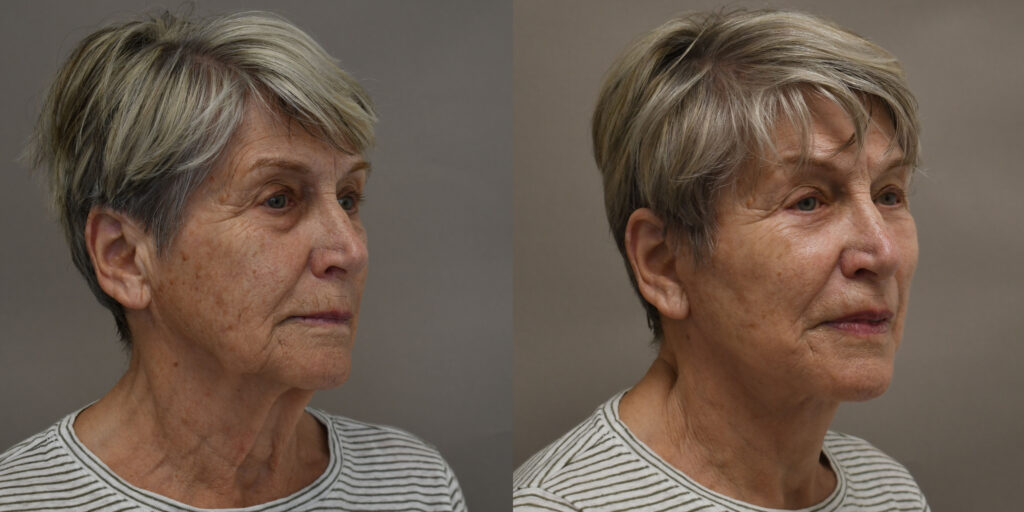
Why My Deep-Plane Facelift Is Different From a Traditional SMAS Facelift
Part 2 of a three-part series on my approach to facial and neck rejuvenation
Patients rarely come to me asking for their SMAS to be tightened or their retaining ligaments to be released. They come because their jawline has softened, jowls have appeared, and the face they see in the mirror no longer reflects how youthful and energetic they feel.
These changes are often described as “loose skin,” but loose skin is only part of the problem.
With aging, the deeper tissues of the face descend. The cheek fat pads shift downward, the attachments supporting the face become restrictive, and the smooth transition between the cheek and jawline begins to disappear. As these deeper structures settle, fullness accumulates along the lower face and creates jowling.
If the deeper tissues have descended, tightening the skin alone cannot fully correct the problem.
My deep-plane facelift is designed to reposition the facial architecture beneath the skin. I release the deeper attachments that prevent movement and elevate the skin, connective tissue and descended fat pads together as a composite unit.
The goal is not to pull the face tighter. It is to restore the tissues to a more youthful anatomical position.
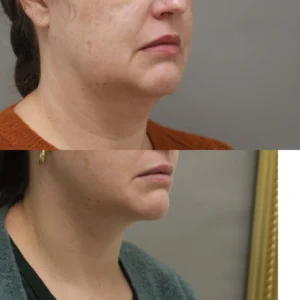
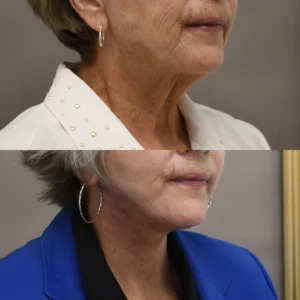
Jowling is not simply loose skin
A youthful jawline is created by the relationship between the cheek, lower face, jaw and neck.
When we are younger, the cheek has natural fullness, the tissues of the lower face are supported, and the transition along the jawline is smooth. With aging, several changes occur simultaneously:
- The cheek fat pads descend
- Facial retaining ligaments become restrictive
- Volume shifts from the upper and central face toward the lower face
- The tissues begin to collect along the jawline
- The mandibular ligament helps define the front edge of the jowl
- The platysma and deeper support system of the face and neck loosen
- Skin elasticity and structural support gradually diminish
The jowl is therefore not an isolated pocket of excess skin or fat. It is the visible result of deeper facial tissues moving downward while remaining tethered at specific anatomical attachment points.
To correct jowling naturally, I must address both sides of that problem: the descended tissues and the ligaments restricting their repositioning.
The face functions as a composite structure
The skin does not age independently from the tissues beneath it. It remains connected to the superficial musculoaponeurotic system—the SMAS—as well as to the fat compartments, retaining ligaments, blood vessels and muscles of facial expression.
Together, these layers form the natural architecture of the face.
In my deep-plane technique, I preserve much of this relationship rather than widely separating the skin from its underlying support system. The skin, SMAS and descended fat pads are mobilized and repositioned as a composite unit.
This allows the deeper tissues to support the correction.
The skin follows the repositioned facial structure instead of being stretched backward to create the appearance of a lift.
Release before repositioning
A structure cannot be repositioned naturally while it remains tethered.
One of the most important steps in my deep-plane facelift is releasing the major retaining attachments that prevent the cheek and lower face from moving freely. These include dense areas of attachment such as MacGregor’s patch, along with other zygomatic, masseteric and mandibular retaining structures when indicated by the patient’s anatomy.
MacGregor’s patch is a particularly strong area of fibrous attachment over the masseter muscle. It helps stabilize the cheek, but with aging it can also restrict the upward repositioning of descended facial tissues.
Trying to lift the face without adequately releasing these attachments is like attempting to reposition a curtain while it remains fastened to the wall. Greater pulling force may tighten the fabric, but it does not restore the material to its natural position.
Once the restrictive attachments are carefully released, the composite facial layer becomes mobile. The cheek fat pads and lower facial tissues can then be returned toward their more youthful position with less dependence on tension.
This is the principle behind my approach:
Release first. Reposition second. Support the result at the deeper level.
How is this different from a traditional SMAS facelift?
A traditional SMAS facelift is a broad category, and individual techniques vary considerably. In many SMAS procedures, the skin is elevated separately and the exposed SMAS is tightened through plication, folding, excision or limited elevation.
These operations can produce meaningful improvement, particularly when properly selected and carefully performed. However, when the major retaining ligaments remain intact, the surgeon may be tightening a layer that is still tethered.
The correction may then depend more heavily on pulling the SMAS—and sometimes the overlying skin—in a lateral or oblique direction.
My deep-plane approach is different because I work beneath the SMAS and release the attachments that prevent the facial tissues from moving. This allows me to reposition the composite layer rather than tightening it against fixed points.
The difference is not simply how deep the dissection goes.
The difference is whether the descended tissues have been adequately released, where the support is placed, and which vector is used to restore the face.
Why the vector matters
Vector refers to the direction in which tissues are repositioned.
This is one of the most important—and frequently overlooked—parts of facelift surgery.
Facial aging does not occur because the face moves directly backward toward the ears. The cheek and facial fat pads generally descend in a more vertical and oblique direction. Correcting that descent with a predominantly backward pull can flatten the cheek, widen the mouth or create an appearance that looks tight without looking youthful.
The relationship between the SMAS and the muscles of facial expression also matters. The SMAS is connected to and continuous with the facial muscular system. If an unreleased SMAS is pulled primarily through tension, that force may be transmitted through its muscular attachments. Depending on the technique and vector, this can temporarily—or occasionally more noticeably—alter the way the face animates.
Smiling is not simply a skin movement. It depends on the coordinated direction and balance of the facial muscles.
In my deep-plane technique, I release the structures tethering the descended tissues and select a vector that restores the cheek and facial fat pads while respecting the natural orientation of the muscles of expression.
I am not relying on pulling the muscles into an unnatural direction to create the lift.
The objective is to reposition the tissues that have descended while preserving the patient’s characteristic smile, expression and animation.
Repositioning the facial fat pads
A youthful face is not flat or uniformly tight. It has natural areas of fullness, soft transitions and balanced curves.
As the face ages, the fat pads do not simply disappear. Many of them shift downward. This contributes to several familiar changes:
- Flattening of the upper cheek
- Deepening of the nasolabial fold
- Fullness beside the mouth
- Development of the jowl
- Loss of a clean jawline
- A heavier appearance in the lower face
Removing or compressing these tissues does not necessarily restore youthfulness. In some patients, it can create a face that looks tighter but also flatter or more hollow.
By releasing and repositioning the composite layer, I can return the descended fat pads toward their natural anatomical position. This restores cheek support, improves the transition into the lower face and reduces the tissue contributing to jowling.
The goal is redistribution—not indiscriminate removal.
Preserving blood supply and tissue architecture
The skin and underlying tissues receive blood through an interconnected vascular network.
Because my technique preserves much of the relationship between the skin and the deeper facial layer, the composite flap maintains a robust blood supply. I also limit unnecessary superficial separation whenever the patient’s anatomy allows.
Preserving this vascular architecture has several potential advantages:
- Less disruption of the superficial tissues
- Better-supported skin
- Reduced dependence on skin tension
- More natural redraping
- Favorable incision healing
- Preservation of normal tissue thickness and texture
Although the term “deep plane” may sound more invasive, a deeper anatomical dissection does not necessarily mean greater trauma to the skin.
In my experience, preserving the composite structure and avoiding excessive superficial undermining can contribute to less bruising and swelling and a smoother recovery. Many patients may also feel socially presentable sooner than they expected.
Recovery, however, remains individual. The extent of surgery, the patient’s anatomy, medical history and healing response all influence bruising, swelling and recovery time. No technique can guarantee a specific recovery experience.
A natural face must also look natural in motion
A facelift should not be judged only in a still photograph.
The face must smile, speak and express emotion. A result that looks smooth at rest but changes the patient’s characteristic animation is not a truly natural result.
This is why preserving the relationship between the facial layers and respecting muscular vectors are central to my technique.
By releasing the retaining structures and repositioning the fat pads in their natural plane, I can restore shape without asking the skin—or the muscles of expression—to hold the result through excessive tension.
The face should remain soft and recognizable.
The patient should still look like herself when she smiles.
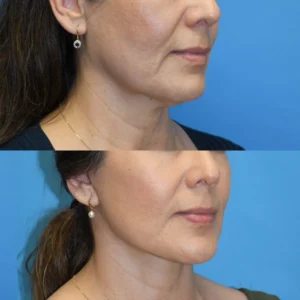
Restoring the jawline from above and below
The jawline is the meeting point of the face and neck. Treating only one side of that relationship may leave the correction incomplete.
From above, the descended tissues of the cheek and lower face contribute to jowling. From below, platysma laxity, submental fullness and deeper neck anatomy can blur the mandibular border.
My deep-plane facelift repositions the facial tissues contributing to the jowl. When indicated, I combine it with the deep-plane neck-lift principles described in Part 1 to restore support beneath the jawline.
This allows the face and neck to be treated as one continuous anatomical system.
The visible result may include:
- A cleaner, more continuous jawline
- Reduction of jowling
- Restoration of natural cheek position
- Improved balance between the cheek and lower face
- A softer transition around the mouth
- Less reliance on skin tension
- Preservation of the patient’s smile and facial animation
- A refreshed appearance without an obvious “facelift look”
Does every patient need a deep-plane facelift?
No.
Not every patient has the same degree of ligament restriction, fat-pad descent, skin laxity or jowling. A younger patient with early changes may benefit from a more limited procedure or a nonsurgical treatment. Other patients require comprehensive correction of the face and neck to create balance.
I evaluate each patient’s facial shape, fat distribution, retaining ligaments, skin quality, muscular activity, jawline and neck anatomy before recommending surgery.
The term “deep plane” should not be used as a marketing label or a standardized operation. The effectiveness of the procedure depends on understanding the anatomy, performing the appropriate release and choosing a vector that fits the individual face.
My philosophy
For me, the central advantage of a deep-plane facelift is not that it is simply “deeper” than a traditional facelift.
Its advantage is that it allows me to release the structures responsible for tethering the aging face and reposition the descended tissues in the anatomical layer where that descent occurred.
I preserve the facial layers as a composite unit. I release attachments such as MacGregor’s patch when necessary. I restore the cheek fat pads toward their natural position. I choose a vector that improves the jawline while respecting the normal direction of facial expression.
The skin is not asked to carry the result, and the muscles are not pulled simply to create surface tightness.
The goal is a face that looks naturally restored—not stretched, flattened or changed.
A successful facelift should improve the cheek, soften the jowl and restore the jawline while preserving the qualities that make the patient recognizable. The patient should look refreshed at rest, natural in motion and entirely like herself.
In Part 3 of this series, I will explain the additional techniques I use to individualize facelift surgery—including the adjunctive procedures that improve facial balance, skin quality and the overall harmony of the result.