
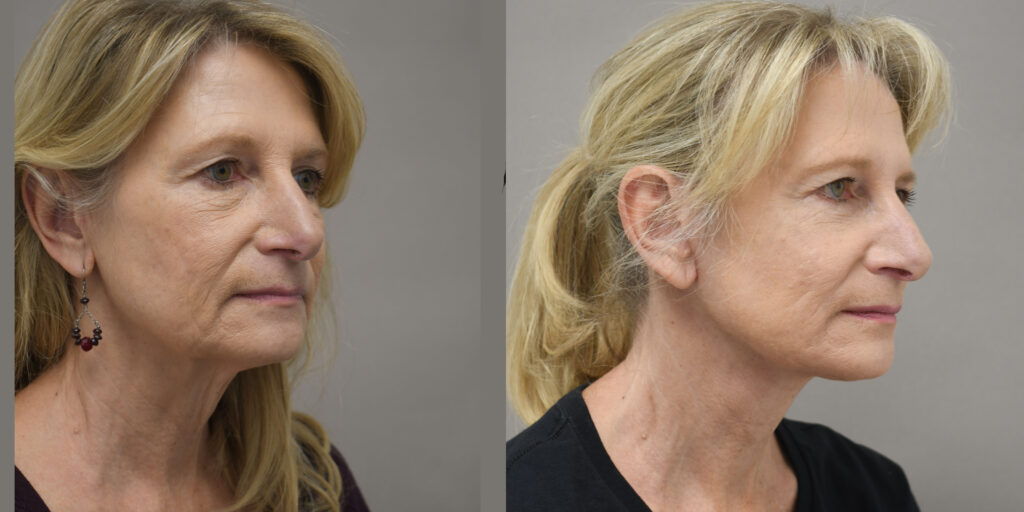
Why My Deep-Plane Neck Lift Is Different From a Traditional Neck Lift
Part 1 of a three-part series on my approach to facial and neck rejuvenation
When most people think about a neck lift, they imagine loose skin being separated, pulled backward and trimmed. Although this can tighten the neck, it treats the skin as if it were simply a covering that needs to be stretched more firmly over the structures beneath it.
My approach is fundamentally different.
In my deep-plane neck lift, I preserve the natural connection between the skin and the platysma muscle beneath it. Rather than widely separating the skin from its muscular foundation, I work in a deeper anatomical plane where the platysma, its fascial attachments, and the overlying skin remain linked as a single functional unit.
I then release the deeper restrictive attachments that tether the platysma, and reposition the muscle using techniques such as a platysma corset or suspension sutures, depending on the patient’s anatomy. Because the skin remains attached to this muscular layer, it is carried into its new position rather than being pulled independently.
This preserves the natural architecture of the neck.
The skin, its supporting connective tissues, and the platysma continue to function as an integrated unit. The lift comes from the muscle—not from tension placed on the skin.
The skin is more than a covering
The skin of the neck does not exist independently from the tissues beneath it. It is connected to an underlying network of supportive fascia, retaining ligaments, blood vessels, and muscular attachments.
Together, these layers create the natural thickness, texture, movement, and contour of the neck.
When the skin is extensively separated from the platysma, part of that integrated system is disrupted. The skin becomes a thinner, more independent layer that must then be redraped and held in position by surface tension alone.
My goal is to preserve that relationship whenever possible.
By keeping the skin attached to the platysma, I maintain the neck as a composite structure. When I reposition the muscle, the skin follows in a predictable and natural way.
This provides support from beneath while preserving the skin’s normal architecture, vascularity, and glide over the underlying tissues.
Why does the neck age?
An aging neck is rarely caused by loose skin alone.
Several anatomical changes occur together:
- The platysma muscle loosens, separates, or descends
- Vertical platysma bands become visible with animation
- Retaining ligaments and fascial attachments restrict repositioning
- Fat accumulates above or beneath the platysma (superficial and subplatysmal compartments)
- The submandibular glands become more prominent or ptotic
- The skin loses elasticity, collagen support, and recoil
A traditional operation may improve the outer appearance by removing superficial fat, tightening the platysma centrally, and pulling the skin laterally.
However, if the deeper structural layer is not adequately addressed, the skin is forced to compensate. It must stretch, redrape, and ultimately “hold” the result on its own.
Skin is not designed to be the primary structural support of a neck lift.
I lift the neck from the muscle
The platysma is the principal muscular support layer of the neck and is continuous with the deeper support system of the lower face.
In my technique, I work in the deep plane beneath the platysma to release the fibrous attachments that restrict its mobility. Once freed, the platysma can be repositioned in a controlled and anatomically natural vector.
I then support it using a platysma corset, suspension sutures, or a combination of both, depending on the patient’s anatomy and degree of laxity.
Because the skin remains attached to the muscle, it follows the deeper tissues into their new position.
The correction is therefore supported by the platysma rather than maintained by tension on the skin envelope.
This is an important distinction. I am not simply pulling the surface backward to tighten the neck. I am restoring the deeper structural foundation and allowing the skin to redrape over a repositioned, more stable framework.
Preserving the skin–muscle architecture
Keeping the skin and platysma together offers several important advantages.
More natural redraping
Because the skin remains connected to its muscular foundation, it moves as part of a composite layer. It does not need to be excessively stretched or thinned to create definition.
This allows the skin to settle more naturally and reduces the tight, over-pulled appearance that can occur when the result depends primarily on surface tension.
Better structural support for the skin
When the platysma is repositioned beneath the skin, it restores a stronger internal scaffold. The skin is supported from below rather than being asked to suspend deeper structures.
This improves how the skin drapes, smooths, and conforms to the underlying contour.
The operation does not change the biological age of the skin. However, by restoring its support system and preserving its architecture, the skin behaves more like a younger, better-supported envelope.
Preservation of natural movement
The neck is dynamic. It moves with speech, swallowing, head rotation, and facial expression.
Maintaining the skin–platysma relationship preserves this dynamic behavior. The goal is not to create a neck that looks fixed or artificially tight, but one that looks naturally younger in motion and at rest.
Less dependence on skin tension
Skin is viscoelastic—it stretches over time. A result that relies primarily on skin tension may gradually soften as that tension relaxes.
By shifting the load of the correction to the deeper muscular layer, the skin is no longer the primary structure responsible for maintaining the result.
I believe this deeper support contributes to improved durability and a more stable long-term contour.
Treating the structures beneath the platysma
Preserving the skin–platysma relationship does not mean ignoring deeper contributors to neck fullness.
Once I am beneath the platysma, I can directly evaluate the subplatysmal anatomy.
When necessary, I conservatively remove subplatysmal fat that cannot be addressed with superficial techniques. If the submandibular glands are prominent or ptotic and contribute to fullness beneath the jawline, I can selectively manage them.
These decisions are highly individualized. Not every patient requires deep structural modification, and the goal is never maximal removal.
The objective is a clean, natural transition from chin to neck without creating an over-sculpted or hollowed appearance.
How is this different from a traditional neck lift?
The fundamental difference is where the operation places its support.
A traditional neck lift often relies more heavily on separating the skin from the underlying structures and tightening it over a reshaped framework. My deep-plane neck lift preserves the skin’s attachment to the platysma and creates the lift by repositioning the deeper muscular layer.
Instead of treating the skin as an isolated outer envelope, I preserve the neck as an interconnected anatomical system.
This allows me to:
- Release deep fascial and ligamentous restrictions
- Reposition and support the platysma in a more youthful vector
- Treat subplatysmal fat directly when present
- Address submandibular gland prominence when indicated
- Preserve the skin–muscle relationship
- Redrape the skin without excessive tension
What does the patient see?
Patients do not come asking for a deep-plane dissection or a platysma suspension. They come because they want a cleaner jawline, less fullness under the chin, and a neck that looks younger without looking operated on.
The visible benefits may include:
- A more defined jawline
- A cleaner chin-to-neck transition
- Reduced submental and neck fullness
- Smoother appearance of platysma bands
- Better-supported, more natural-looking skin
- Preservation of natural movement
- Less visible tension around incision lines
- A result designed for long-term stability
The goal is not simply tighter skin. It is a more youthful neck structure supported from within.
Does everyone need a deep-plane neck lift?
No.
A younger patient with good skin elasticity and primarily superficial fat may require only liposuction. Others may benefit from a more limited or targeted procedure. Subplatysmal fat or submandibular gland management is only performed when these structures are true contributors to the patient’s anatomy.
The term “deep plane” should never replace surgical judgment.
Each operation is customized after evaluating the skin, platysma, superficial and deep fat compartments, submandibular region, chin projection, and jawline definition. I treat the anatomical cause of each patient’s concern rather than applying a uniform technique.
My philosophy
The best neck lift does not force the skin to create a shape that the deeper anatomy cannot support.
I preserve the connection between the skin and muscle, release the structures that restrict movement, and lift the neck from its muscular foundation. The skin then redrapes naturally over a restored internal framework rather than being stretched into position.
For me, this is the central advantage of a deep-plane neck lift: preservation of the neck’s natural architecture while restoring its deeper support system.
The result should not look pulled, hollow, or surgically altered. It should look like the patient’s own neck—cleaner, smoother, better supported, and naturally younger.
In Part 2 of this series, I will explain how my deep-plane facelift differs from a traditional SMAS facelift and how preserving and repositioning the deeper facial architecture can rejuvenate the cheeks, jawline, and lower face.