
Many patients seek facial rejuvenation because they “look tired” despite feeling energetic and healthy. While excess upper eyelid skin is often blamed, the true cause is frequently a descent of the eyebrows. When the brow falls, it pushes additional skin onto the upper eyelids, creating a heavy, fatigued appearance. Treating the eyelids alone in these patients often fails to address the underlying problem.
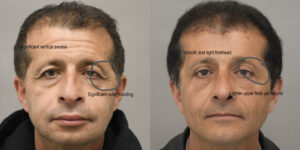
This patient presented with concerns that he constantly appeared tired. Examination demonstrated significant upper eyelid skin redundancy, but more importantly, marked brow ptosis, particularly of the lateral brows. He also had a tall forehead with deep forehead rhytids and excess forehead skin.
After discussing his goals, we elected to perform a pretrichial open brow lift. This approach was chosen because it allowed us to accomplish several objectives simultaneously: elevate the brows to a natural, youthful position, shorten the height of the forehead, remove excess forehead skin, and soften the deep forehead lines while preserving a masculine, natural appearance.
The postoperative photographs demonstrate a refreshed yet subtle result. His eyebrows have been restored to an appropriate position without looking over-elevated or surprised. The upper eyelids appear more open and rested because the brow is once again providing proper support. The forehead is smoother and proportionally shorter, creating better facial balance. The incision along the hairline has healed exceptionally well and is difficult to appreciate
.
This case highlights an important principle in facial rejuvenation: the correct diagnosis is often more important than the operation itself. In patients with brow ptosis, restoring the brow position rather than simply removing eyelid skin creates a more natural, balanced, and longer-lasting result.