
This patient presented more than 20 years after her original rhinoplasty. She explained that she had been unhappy with the appearance of her nasal tip ever since her first surgery, but had delayed seeking treatment because her previous experience had made her apprehensive about undergoing another operation.
The decision to proceed with revision rhinoplasty is often challenging as patients lose trust in predictability of the outcome. It is important to take the time to review and assess both the patient goals and expectations as well as the anatomy of the nose. Aligning goals and outcome is key in patient satisfaction.
Her primary concerns were a poorly defined, amorphous nasal tip, excessive projection, and an overall lack of harmony between her nose and the rest of her face. Her goal was a natural-appearing nose with softer contours, improved tip definition, appropriate deprojection, and a smooth, balanced transition from the bridge to the tip.
During our consultation, we discussed that revision rhinoplasty is fundamentally different from primary rhinoplasty. Although preoperative examination suggested that the tip cartilages had likely been significantly altered, I explained that the true extent of the deformity would not be known until the nose was completely opened during surgery.
Goals:
- Natural tip
- Deprojection
- Smooth bridge
- a more Straight nose
Once the nose was opened, the findings were even more dramatic than anticipated. The normal tip-defining domes had been completely divided and removed, leaving only the lateral crura of the lower lateral cartilages. The normal structural architecture responsible for creating a stable, natural nasal tip no longer existed.
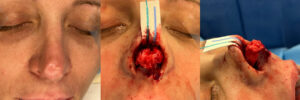
Because of these findings, I proceeded with a complete extracorporeal tip reconstruction.
Both lateral crura were meticulously dissected free and temporarily removed to the extracorporeal side table. Septal cartilage and any additional usable cartilage were carefully harvested to provide structural graft material. A new medial crural support was reconstructed using the remaining native septal cartilage. Each lateral crus was then individually reshaped to create a new dome, effectively rebuilding the missing tip architecture. Underlay lateral strut grafts were placed to recreate stable lateral crura and restore long-term support, symmetry, and contour.
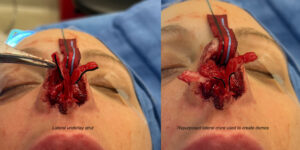
After reconstruction of the nasal tip framework, the remainder of the rhinoplasty was completed in a standard fashion. The dorsal hump was refined, lateral osteotomies were performed to straighten the bony pyramid, septal deviations were corrected, and the reconstructed framework was refined to achieve balanced projection and smooth aesthetic lines.
The postoperative photographs demonstrate a dramatic transformation while maintaining a natural appearance. The nose is straighter, the tip has been restored with refined definition and gentle contour, projection has been appropriately reduced, and the entire nose now flows harmoniously with the patient’s facial features. Most importantly, the reconstruction recreated a stable structural framework designed to provide both lasting support and a natural aesthetic result.
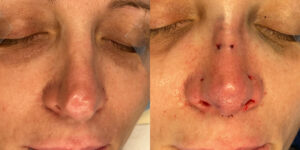
Revision rhinoplasty often requires reconstruction rather than simple refinement. In patients whose normal anatomy has been significantly altered by previous surgery, advanced structural techniques such as complete extracorporeal tip reconstruction can restore both function and natural beauty, even decades after the original operation.