
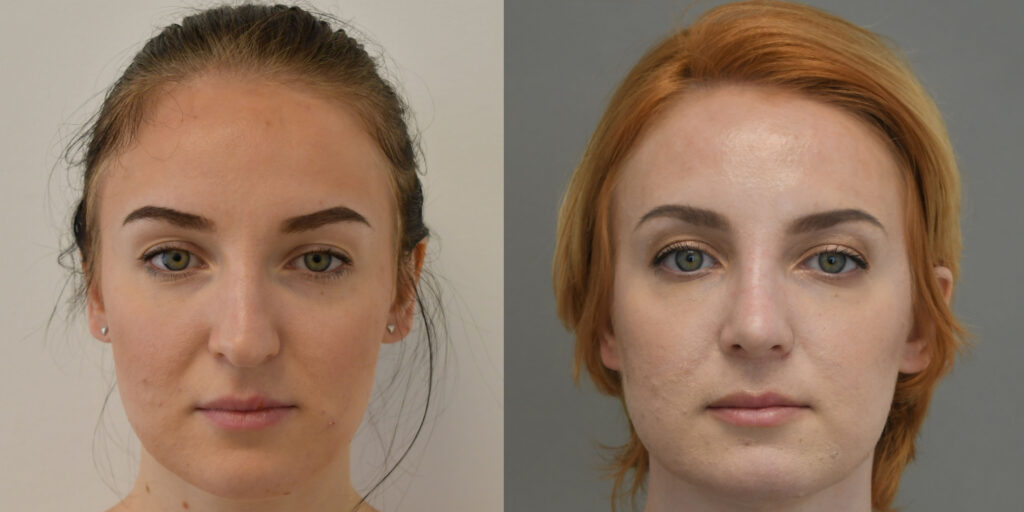
Avoiding the Pinched Tip in Rhinoplasty
The nasal tip is one of the most important elements of rhinoplasty because it has such a strong influence on whether the final result looks natural. The tip is where the bridge, nostrils, alae, and columella come together visually and structurally. When these relationships are balanced, the nose flows naturally and does not call attention to the surgery. When the tip is made excessively narrow, however, it can develop the characteristic “pinched tip” appearance, one of the features that can immediately give away a rhinoplasty.
Avoiding a pinched nasal tip requires more than simply preserving cartilage or making the tip less narrow. It requires understanding nasal tip anatomy, tip-defining points, alar base width, cartilage support, and the three-dimensional relationship between the tip, columella, and alae.
What Makes a Nasal Tip Look Natural?
One of the most common misconceptions about tip rhinoplasty is that a more refined nasal tip is simply a smaller or narrower tip.
It is not.
A beautiful nasal tip needs definition, but it also needs proportion. If the tip is narrowed too aggressively, the central portion of the nose can look constricted while the nostrils and alae appear disproportionately wide. Instead of creating refinement, excessive narrowing can produce a sharp, artificial, or operated appearance.
The goal of tip rhinoplasty is therefore not to create the smallest possible tip. It is to create the appropriate tip definition, width, projection, rotation, shape, and structural support for that particular nose and face.
Understanding Nasal Tip Anatomy
Although we commonly refer to the nasal tip as a single structure, it is actually a three-dimensional framework formed primarily by the paired lower lateral cartilages and their overlying soft tissues.
The shape, position, strength, and relationship of these cartilages influence several important features of the nose:
- Tip width and definition
- Tip projection
- Tip rotation
- Nostril shape
- Alar contour
- The relationship between the columella and alar rims
This is why the nasal tip cannot be treated in isolation. A technically attractive tip must also remain proportional to the nasal bridge, alar base, nostrils, columella, and the patient’s overall facial anatomy.

Tip-Defining Points: Definition Without a Pinched Appearance
From the frontal view, an attractive nasal tip typically has two subtle tip-defining points corresponding to the domal portions of the lower lateral cartilages.
These points provide definition and help give the tip its shape.
But tip definition does not mean bringing these points as close together as possible.
If the domes are narrowed excessively, the central tip can become unnaturally sharp or pinched. Just as importantly, excessive narrowing can disrupt the transition from the central tip to the wider alae.
A natural nasal tip should have definition without compression. The tip-defining points should be recognizable, but they should remain part of a smooth contour that flows into the rest of the nose.
Why a Smaller Nasal Tip Is Not Always Better
Patients frequently ask for their nasal tip to be made “smaller.” What they often actually want is a tip that looks less bulbous, better defined, and more proportional.
Those are not necessarily the same thing as making the tip as narrow as possible.
Every part of the nose exists in relationship to the structures around it. If the tip is progressively narrowed without considering those relationships, eventually it becomes disproportionately small.
At that point, the nose may look less natural rather than more refined.
In rhinoplasty, the goal should not be maximal reduction. It should be proportional refinement.
Nasal Tip Width and Alar Base Width
One of the most important relationships in frontal-view rhinoplasty is the relationship between nasal tip width and alar base width.
The alar base is defined by the outer boundaries of the nostrils. The nasal tip sits within this broader framework.
When the tip is narrowed appropriately, the eye should see a smooth transition from the tip-defining points outward toward the alae.
If the central tip becomes excessively narrow while the alar base remains relatively wide, the relationship becomes unbalanced. The middle of the nose appears constricted while the nostrils and alae may appear to flare outward.
This disproportion is an important component of the classic pinched nasal tip deformity.
There is no single ideal tip-to-alar-base ratio that should be imposed on every patient. Skin thickness, cartilage strength, nasal length, projection, facial width, sex, ethnicity, and the patient’s preexisting anatomy all influence the appropriate proportions.
The important concept is not a single number. It is the relationship and transition between the structures.
Nasal Proportion and the Concept of Flow
I think about rhinoplasty not only in terms of measurements, but also in terms of flow.
The eye should move naturally from the nasal bridge toward the tip and then from the tip outward toward the alae and nostril margins. There should not be an abrupt point where one portion of the nose suddenly becomes much narrower or wider than the structure next to it.
This concept is especially important in nasal tip surgery.
A well-designed tip should look as though it naturally belongs to the nose. It should not look like a small, sculpted tip has been surgically placed onto a wider nasal base.
That distinction is central to creating a natural-looking rhinoplasty result.
How I Avoid a Pinched Tip During Rhinoplasty
The technical challenge is straightforward to describe but more difficult to execute: How do we narrow and define the nasal tip without destroying the natural architecture that gives the tip and nostrils their shape?
Modern tip rhinoplasty is less about simply removing cartilage and more about reshaping, repositioning, and supporting cartilage.
When I refine the nasal tip, my objective is to change the shape and position of the lower lateral cartilages while preserving the natural relationship between the tip, columella, alae, and nostril margins.
Reshaping the Tip Rather Than Simply Removing Cartilage
Historically, aggressive cartilage removal was often used to reduce a wide or bulbous nasal tip.
The problem is that cartilage is not simply excess tissue. It is also the structural framework supporting the nasal tip and alae.
Removing too much cartilage can weaken that framework and contribute to pinching, alar retraction, nostril distortion, or other contour abnormalities.
For that reason, my preference is to preserve cartilage whenever possible and use controlled techniques to bend, fold, reposition, and support the existing cartilage.
This allows the tip-defining points to be refined while maintaining the structural integrity of the lower lateral cartilages.
Preserving the Columella-Alar Vectors
One of the most important concepts in avoiding a pinched nasal tip is preserving the natural relationship between the columella and alae.
When the domes are brought closer together to narrow the tip, the remainder of the lower lateral cartilage should not simply be pulled inward with them.
The columella and alae have natural vectors. As I narrow and shape the central tip, I want to preserve those vectors so the alae continue to extend naturally outward from the tip.
In other words, tip refinement should not mean squeezing the entire lower lateral cartilage complex toward the center.
Instead, the cartilage is reshaped in three dimensions: narrowing and defining the central tip while maintaining the appropriate direction, support, and contour of the lateral portions of the nose.
This allows the tip to become more refined without creating the abrupt transition characteristic of a pinched nose.
The Role of Alar Underlay and Lateral Crural Extension Grafts
In selected rhinoplasty patients, alar underlay grafts and lateral crural extension grafts can help preserve or restore the architecture of the lateral nasal tip.
These cartilage grafts can provide support to the lateral portion of the lower lateral cartilage and help control its position and direction.
As the central tip is narrowed, appropriate structural support can help maintain the desired outward vector of the lateral crus rather than allowing it to be pulled excessively toward the center.
This can be particularly useful when the patient’s lateral cartilage is weak, malpositioned, excessively curved, or lacks adequate support.
The purpose of these grafts is not simply to add cartilage. Their purpose is to control the geometry, position, and stability of the tip and ala.
The Role of Alar Rim Grafts
Alar rim grafts can provide another layer of control and support.
These are small cartilage grafts positioned along the nostril margin to support and shape the alar rim. Depending on the patient’s anatomy, they can help maintain a smooth alar contour, support the nostril margin, reduce excessive concavity, prevent or correct alar retraction, minimize notching, and improve the transition between the nasal tip and ala.
When appropriately used, an alar rim graft helps maintain a continuous, natural contour from the central tip into the nostril margin.
The Goal: A Refined Nasal Tip That Does Not Look Operated
Ultimately, I do not judge the success of tip rhinoplasty by how narrow I can make the nasal tip.
I look at the relationship between the tip-defining points, alar base, nostrils, columella, nasal bridge, and the face as a whole.
The tip-defining points should be visible without appearing sharp. The alae should transition naturally away from the tip. The nostril margins should remain smooth and supported. And the width of the tip should remain appropriate for the width and shape of the alar base.
This is why two patients who both ask for a “smaller nasal tip” may require very different rhinoplasty techniques.
The goal is not to create the smallest possible nose or the narrowest possible tip. The goal is to create a refined, proportional nose in which every component flows naturally into the next—and nothing about the tip gives away the fact that a rhinoplasty was performed.