

The Belly Button After a Tummy Tuck: My Approach to Creating a Natural Umbilicus
A beautiful tummy tuck can be diminished by an unnatural-looking belly button.
Patients understandably focus on the larger changes created by an abdominoplasty—the removal of excess skin, tightening of the abdominal wall, and improvement in abdominal contour. But the belly button sits in the center of that result. If it looks too round, too large, too flat, excessively hooded, or obviously surgical, it can distract from an otherwise beautiful abdomen.
For that reason, I consider umbilicoplasty—the shaping and positioning of the belly button during a tummy tuck—an important part of the operation, not simply a finishing step.
My goal is not to create the same belly button on every patient. I start with the patient’s natural anatomy and try to preserve its character while adapting it to the patient’s new abdominal contour.
What Happens to the Belly Button During a Tummy Tuck?
A common misconception is that a tummy tuck creates a new belly button.
In a standard abdominoplasty, the patient’s original belly button remains attached to the abdominal wall by its stalk. I separate the surrounding abdominal skin from the umbilicus, allowing the abdominal skin to be pulled downward and the excess removed.
The original belly button is then brought through a new opening in the repositioned abdominal skin.
The design and location of that opening—and how the underlying umbilicus is shaped and secured—have a significant effect on the final appearance.
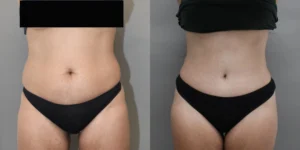
I Start With the Patient’s Natural Belly Button
There is no single belly-button shape that is ideal for every patient.
Before surgery, I look at the patient’s existing umbilicus: its shape, width, depth, position, and degree of hooding.
For most patients, I find that a relatively narrow vertical oval creates an attractive, natural appearance. But even among vertical umbilici, there is considerable variation.
I don’t want every patient leaving surgery with my standardized belly button. I want the final umbilicus to look appropriate for that patient’s anatomy.
The Width Starts With the Existing Umbilical Base
Once I have isolated the umbilical stalk, one of the first things I evaluate is the width of its base.
Importantly, I reassess it after completing the muscle plication.
Plication changes the tension across the abdominal wall. Once the muscles have been tightened, much of the tension and distortion around the umbilical base may resolve. At that point, I can see its true width and shape more accurately.
If necessary, I make subtle modifications to the base to improve its shape.
This gives me control over one of the fundamental dimensions of the final belly button rather than simply choosing an arbitrary opening size.
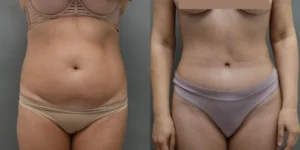
Controlling the Depth of the Belly Button
A natural belly button is three-dimensional.
If it is too shallow, it can look flat or appear to sit on top of the abdominal skin. If it is excessively deep, that can look unnatural as well.
Once I am satisfied with the shape and width of the umbilical base, I use suture fixation to control the effective length and position of the stalk.
This allows me to control depth independently from width.
That distinction is important. The size of the skin opening alone does not determine whether a belly button will have natural depth.
Why I Make a Horizontal Oval to Create a Vertical Belly Button
This is one of the more counterintuitive parts of my technique.
If I ultimately want a vertically oriented belly button, why would I create a horizontal oval opening?
Because I am not designing the opening based only on what it looks like when I make the incision. I am designing it based on what the surrounding abdominal skin is going to do to it.
After the abdominal skin has been pulled downward and redraped, there is significant vertical tension as well as a different degree of horizontal laxity.
I assess both.
Based on the size of the patient’s umbilicus and these forces, I create a horizontal oval opening. The vertical tension on the abdominal skin then transforms that opening toward the vertical oval shape I want in the final result.
In other words, I don’t simply cut the shape I want to see. I anticipate how the tissues will change that shape.
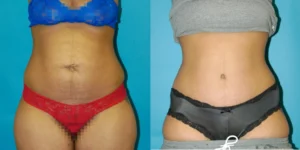
Controlling the Hooding
The subtle hood at the upper portion of the belly button is another important feature.
Too little hooding can leave the entire umbilicus exposed and make it look flat. Too much can create an obvious shelf that looks artificial.
I can influence the amount of superior hooding by changing the location of the skin opening relative to the underlying umbilical stalk.
This gives me another variable I can adjust based on the individual patient’s anatomy rather than creating the same amount of hooding in everyone.
What Makes a Tummy Tuck Belly Button Look Unnatural?
Many different techniques for umbilicoplasty have been described. These include circular and vertical openings, V-shaped and U-shaped flaps, and a variety of other geometric designs. Good results can be obtained with many of these techniques.
My concern is less about the name of the technique and more about the final appearance.
There are several characteristics I generally try to avoid:
- A perfectly round or “button-like” belly button
- An excessively narrow vertical slit
- An umbilicus that is too large for the patient’s abdomen
- A shallow or flat appearance
- Excessive superior hooding
- A conspicuous circumferential scar
- An umbilicus that appears pasted onto the abdominal surface
- The same belly-button shape on every patient
This is one reason I prefer not to start with a predetermined geometric template and make the patient’s anatomy conform to it.
I prefer to start with the anatomy and work in the opposite direction.
Shape, Width, Depth, Hooding, and Tension Are Separate Variables
I think about several components of the umbilicus independently during a tummy tuck.
Shape: What did the patient’s natural belly button look like, and what shape will look appropriate on the new abdomen?
Width: What is the actual width of the umbilical base after muscle plication?
Depth: How should the stalk be positioned and secured to create an appropriate natural depression?
Hooding: Where should the opening be positioned to produce the appropriate amount of superior coverage?
Skin tension: How will vertical tension and horizontal laxity alter the shape of the opening once the abdominal skin has been redraped?
Thinking about these separately gives me considerably more control than simply creating a standardized opening and bringing the umbilicus through it.
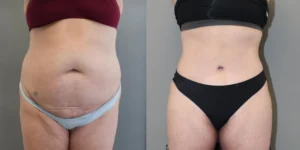
What About the Scar Around the Belly Button?
In a standard tummy tuck, an incision around the umbilicus is generally necessary because the original belly button must be brought through the newly positioned abdominal skin.
The goal isn’t to pretend there is no incision. The goal is to make the scar as inconspicuous as possible by incorporating it into the natural contours, depth, and shadows of the umbilicus.
Scar quality also varies among patients and continues to change as healing progresses.
Does the Belly Button Change During Tummy Tuck Recovery?
Yes.
Early after surgery, swelling and tissue tension can affect the appearance of the belly button. The abdominal tissues gradually soften and settle, and the scars continue to mature over many months.
For this reason, I don’t judge the final appearance of an umbilicus during the first few weeks after surgery.
My objective during surgery is to establish the shape, dimensions, depth, and tissue relationships that will allow the belly button to develop a natural appearance as healing progresses.
Can a Tummy Tuck Belly Button Be Revised?
Yes, in selected patients.
Depending on the problem, umbilical revision can sometimes improve scar visibility, size, constriction, shape, depth, or hooding.
But as with most aspects of plastic surgery, prevention is preferable to revision. I would rather think carefully about each of these variables during the original tummy tuck than try to correct them later.
My Goal: A Belly Button That Belongs on That Abdomen
I don’t believe there is one “perfect” belly button.
A petite patient with a narrow torso should not necessarily have the same umbilicus as someone with a broader abdominal wall. Likewise, a patient who naturally had a small vertical belly button before pregnancy may require a different approach from someone whose umbilicus was naturally wider or more hooded.
My objective is not to reproduce the same belly button on every patient.
My goal is to create an umbilicus that looks as though it belongs on that patient’s abdomen.
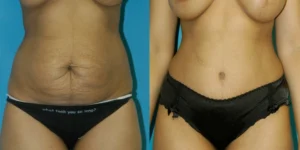
Ideally, the belly button should not be the first thing someone notices after a tummy tuck. It should simply look natural enough that it becomes part of the overall abdominal contour.
A belly button is a relatively small part of an abdominoplasty, but it illustrates an important principle in plastic surgery: small details can have a significant effect on how natural the final result looks.
Beyond the Tummy Tuck: What a Comprehensive Abdominoplasty Includes