

My Dermal Shelf Technique :
Using Your Own Tissue for Internal Support During a Breast Lift
One of the challenges in breast lift and breast augmentation with lift surgery is not simply creating a beautiful breast shape—it is supporting that shape over time.
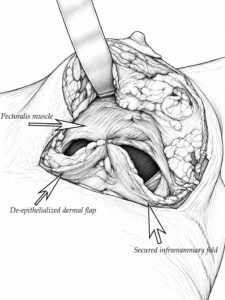
During an anchor-pattern breast lift, also called a Wise-pattern mastopexy, excess skin is normally removed from the lower breast. In selected patients, rather than discarding all of this tissue, I preserve a portion of it and remove the surface epithelium while maintaining the deeper dermal tissue. This creates a de-epithelialized inferior dermal flap.
I use this patient’s own tissue as an internal support layer—what I call my dermal shelf.
The dermal shelf can help reinforce the lower pole, control the inframammary fold (IMF), support an implant when one is used, and provide an additional layer of tissue between the implant and the external breast skin.
Why Does a Breast Lift Need Internal Support?
A breast lift reshapes the breast and removes excess skin, but the skin itself is not necessarily the best structure to support the weight of the breast over many years.
In fact, many women seeking breast lift surgery already have skin and soft tissues that have stretched from pregnancy, weight changes, aging, genetics, or the weight of the breast itself.
If an implant is added during an augmentation mastopexy, there is additional weight for these tissues to support.
This is why I think about a breast lift as having two components:
The external skin envelope shapes and covers the breast, while the deeper tissues provide structural support.
What Is a De-Epithelialized Inferior Dermal Flap?
A de-epithelialized inferior dermal flap uses the patient’s own tissue to create additional internal breast support.
During an anchor breast lift, some of the lower breast skin would normally be removed. In appropriate patients, I preserve a portion of this tissue and de-epithelialize it, removing the superficial skin layer while maintaining the stronger underlying dermis.
Because the tissue remains attached, it remains living, vascularized autologous tissue.
Instead of discarding this potentially useful tissue, I reposition it internally and use it as a dermal shelf or sling beneath the breast.
How I Use the Dermal Shelf
The exact configuration depends on the patient’s anatomy and whether an implant is being used.
I first establish and reinforce the desired inframammary fold (IMF), the crease that defines the lower boundary of the breast.
The dermal flap is incorporated into this reconstruction to provide an additional layer of support along the lower breast.
When I am using a subpectoral or dual-plane implant, the implant has muscle coverage superiorly. The dermal flap can provide additional autologous coverage and support inferiorly and can be secured to the inferior aspect of the pectoralis to create a supported lower pocket.
The result is an internal support system created substantially from the patient’s own tissue.
Better Control of the Inframammary Fold
The inframammary fold is one of the most important structural landmarks in breast surgery.
It defines the lower boundary of the breast and influences breast height, lower-pole length, implant position, and overall breast shape.
If the fold stretches or an implant migrates below it, the lower breast can become excessively long, contributing to bottoming out or recurrent lower-pole laxity.
The dermal shelf gives me another layer of tissue that can be incorporated into the support of the lower breast and IMF rather than relying entirely on the external skin closure.
Double Support of the Lower Pole
One of the principal reasons I use this technique is what I think of as double support of the lower pole.
The external breast skin remains the outer envelope.
Beneath it, the de-epithelialized dermal flap creates a second supportive tissue layer.
Instead of asking the external breast skin alone to support the breast or implant, the lower pole has:
External skin coverage + internal autologous dermal support.
This creates an additional structural layer beneath the skin and reduces reliance on the external skin envelope alone.
Additional Implant Coverage—Especially in Thin Patients
The dermal shelf can provide another important benefit during breast augmentation with lift: additional implant coverage.
This can be particularly valuable in thinner patients.
When breast tissue and subcutaneous fat are thin, the implant may be easier to see or feel, particularly along the lower breast where there is less muscle coverage.
By preserving the patient’s dermis rather than removing it, I can create another layer of her own tissue between the implant and the external breast skin.
This additional tissue can help camouflage the implant, soften the transition between the implant and surrounding breast, and decrease how easily the implant can be seen or felt in areas with limited soft-tissue coverage.
Published augmentation-mastopexy techniques using inferior dermal or dermoglandular flaps have similarly described the advantage of additional implant coverage.
Why I Prefer Autologous Tissue When It Is Available
Autologous means that the tissue comes from the patient’s own body.
When good-quality dermal tissue is already available during an anchor breast lift, I see an advantage in using that tissue before automatically adding another material.
A de-epithelialized inferior dermal flap provides:
- the patient’s own living tissue
- additional lower-pole support
- improved control of the inframammary fold
- an additional layer of implant coverage
- less reliance on the external skin envelope alone
- additional camouflage of an implant in thinner patients
- tissue that would otherwise largely be discarded during the lift
This does not mean that every patient should have a dermal flap or that mesh is never useful. Tissue quality varies considerably, and some patients may benefit from additional reinforcement.
My preference is to use the patient’s own tissue when it can provide meaningful support and add other materials selectively when there is a reason to do so.
Dermal Shelf vs. Mesh
A dermal shelf and surgical mesh are fundamentally different types of support.
The dermal shelf is living autologous tissue. A surgical mesh or scaffold is an implanted material designed to reinforce the breast while the patient’s tissues heal and remodel around it.
For a patient with adequate dermal tissue, the dermal shelf may provide the additional support I want without mesh.
For patients with very thin or weak tissues, recurrent bottoming out, previous breast surgery, or greater mechanical demands from an implant, additional mesh reinforcement may be beneficial.
The two techniques can also be complementary.
The goal is not to add more material to every breast. It is to provide the appropriate support for the anatomy and tissue quality of that particular patient.
Why This Is Particularly Useful in Breast Augmentation With Lift
A breast augmentation with lift, or augmentation mastopexy, creates a unique mechanical challenge.
We are simultaneously tightening and lifting the breast while adding volume and weight with an implant.
This makes control of the lower pole and inframammary fold particularly important.
I think about the operation in layers:
The breast lift reshapes and elevates the breast.
The implant provides volume and projection.
The inframammary fold establishes the lower boundary.
The de-epithelialized dermal flap provides additional autologous support and implant coverage.
The external skin completes the breast envelope.
This allows me to think not only about the breast shape I create during surgery, but also about how that breast and implant will be supported afterward.
Does a Dermal Shelf Prevent Future Breast Sagging?
No surgical technique can permanently prevent the breast from aging.
Gravity, pregnancy, weight changes, breast and implant weight, genetics, and the patient’s underlying tissue quality continue to affect the breast after surgery.
The purpose of the dermal shelf is therefore not to promise that the breast will never change.
Its purpose is to provide a second layer of autologous support, improve control of the lower pole and inframammary fold, reduce dependence on the external skin envelope, and provide additional tissue coverage over an implant.
My Philosophy: Use the Tissue We Already Have
Breast lift surgery is about more than removing excess skin.
When I perform an anchor-pattern breast lift, I look at the tissue that would normally be removed and ask whether some of it can instead become part of the reconstruction.
In the appropriate patient, a de-epithelialized inferior dermal flap allows me to convert that tissue into a useful internal structural layer—my dermal shelf.
For me, its advantages are straightforward:
better control of the inframammary fold, double-layer support of the lower pole, less reliance on the external skin envelope, and an additional layer of the patient’s own tissue over an implant—particularly valuable in thinner patients.
It is one of several techniques I use to individualize breast lift and augmentation-mastopexy surgery based on the patient’s breast anatomy, tissue quality, implant choice, and long-term goals.
Breast Lift and Augmentation Mastopexy in Walnut Creek, the East Bay & San Francisco Bay Area
Dr. Afshin Parhiscar is a double board-certified plastic surgeon performing breast lift, breast augmentation with lift, and revision breast surgery in Walnut Creek, California, for patients throughout the East Bay, San Francisco Bay Area, and beyond.
Breast lift planning includes evaluation of breast shape, nipple position, inframammary fold anatomy, skin and soft-tissue quality, implant selection when appropriate, and whether additional internal support with an autologous dermal flap, mesh, or another technique may be beneficial.
The goal is not simply to create an attractive breast immediately after surgery, but to develop an individualized operation that considers breast shape, implant coverage, lower-pole support, and long-term tissue behavior.