
The Role of Imaging in Rhinoplasty: Why Communication Is Essential
How computer imaging helps patients communicate their goals and surgeons develop realistic, individualized rhinoplasty plans.
One of the most important steps in achieving a successful rhinoplasty result happens long before surgery. It begins with communication.
Patients often know what they like or dislike about their nose, but describing exactly what they want to change can be surprisingly difficult.
A patient might say, “I want a smaller nose,” or “I want a more refined nasal tip.” But what does that actually mean?
Does the patient want a lower nasal bridge? Less tip projection? More tip rotation? A narrower tip? A different relationship between the tip and the bridge?
These are distinct changes, each requiring different surgical considerations. Even when patients and surgeons use the same words, they may envision very different results.
Computer imaging helps bridge this communication gap by allowing patients and surgeons to visualize and discuss specific changes before rhinoplasty surgery.
What Is the Role of Computer Imaging in Rhinoplasty?
Computer imaging, sometimes called rhinoplasty simulation or digital morphing, allows a surgeon to modify photographs of a patient’s nose to illustrate potential changes in its appearance.
Its greatest value, however, is not simply showing what a nose might look like after surgery.
The primary purpose of rhinoplasty imaging is to improve communication between the patient and surgeon, clarify aesthetic goals, and guide surgical planning.
Rather than relying entirely on descriptions, patients can compare visual alternatives and identify precisely which changes they prefer.
My Approach: Imaging as a Conversation
In my Walnut Creek practice, rhinoplasty imaging is an interactive, step-by-step process between the patient and me.
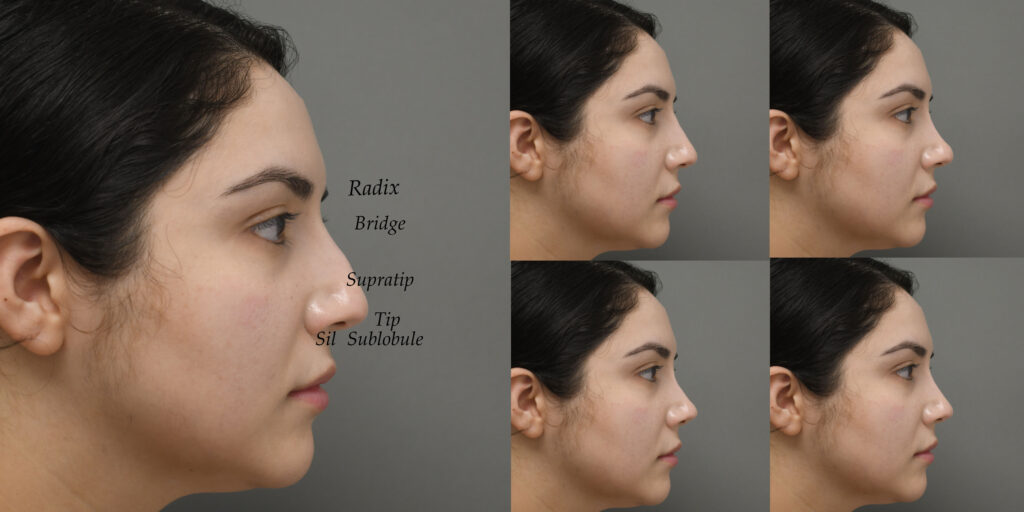
Rather than generating a single modified image and asking whether the patient likes it, we work through the nose together, changing one variable at a time.
We might begin with the nasal bridge. Would you prefer it straighter? Slightly lower? With a subtle curve?
We compare the images side by side.
Then we address the nasal tip. Would you prefer less projection? More rotation? A different degree of definition?
We continue through the profile, frontal view, and other aspects of the nose that matter to the patient.
Each change becomes a simple visual decision: Yes, I prefer that. No, I don’t. Or perhaps somewhere in between.
This back-and-forth eliminates much of the ambiguity of verbal descriptions. It also helps patients recognize preferences they may not have been able to articulate.
My goal is not to design a nose and persuade the patient to like it. My goal is to understand what the patient actually wants.
How Is Surgeon-Guided Imaging Different From AI Rhinoplasty Simulation?
Artificial intelligence can generate impressive images of an aesthetically pleasing nose. However, creating an attractive image is not the same as developing a realistic rhinoplasty plan.
Many AI rhinoplasty simulations do not adequately address two essential considerations simultaneously:
1. The patient’s individual aesthetic preferences
An AI-generated nose may follow certain aesthetic proportions or generalized beauty standards, but those proportions do not necessarily reflect what an individual patient wants.
Some patients prefer a straight nasal bridge, while others prefer a subtle curve. Some want a more projected tip; others want less projection.
There is no single ideal nose for every patient.
2. What is surgically achievable given the patient’s anatomy
A digitally generated image does not necessarily account for skin thickness, cartilage strength, nasal bone structure, existing asymmetries, previous surgery, or the limitations of healing.
These factors determine which changes can be achieved safely and predictably.
Although AI technology continues to evolve, an attractive simulation should not be confused with a surgically validated prediction.
The essential question is not simply, “What would look good?” It is, “What does this patient want, and what can realistically be achieved with their anatomy?”
Answering both questions requires individualized evaluation, communication, and surgical judgment.
How Does Rhinoplasty Imaging Help Create a Surgical Plan?
Once I understand the patient’s aesthetic preferences through imaging, I evaluate those goals in the context of their individual nasal anatomy.
Some changes may be relatively straightforward. Others may require cartilage grafting, structural support, or modifications to the original goals.
Occasionally, a change that looks attractive on a computer screen may not be realistic or surgically advisable.
This is an important part of the consultation.
Imaging is not a guarantee of the final result. It is a communication and planning tool that helps establish a shared understanding of the desired outcome while respecting the limitations of anatomy, surgical technique, and healing.
The surgical plan becomes individualized not based on a generic ideal nose, but on the patient’s specific goals and what can safely and realistically be achieved.
Why Small Changes Matter in Rhinoplasty
In rhinoplasty, even a few millimeters can make a significant difference.
A subtle change in nasal bridge height, tip projection, or tip rotation can alter the overall appearance and character of the nose.
These details can be difficult to communicate with words alone, but much easier to understand when comparing images side by side.
The imaging process also helps identify features patients want to preserve, which can be just as important as identifying what they want to change.
Frequently Asked Questions About Rhinoplasty Imaging
Can computer imaging predict my rhinoplasty results?
No. Computer imaging illustrates possible aesthetic changes, but it cannot reliably predict the exact postoperative result. Healing, tissue characteristics, surgical limitations, and individual anatomy all influence the outcome.
Is AI rhinoplasty imaging accurate?
AI imaging can produce realistic-looking simulations, but visual realism does not establish surgical feasibility. A simulation may not reflect a patient’s specific preferences or the anatomical limitations that determine what can actually be achieved.
Why is imaging important during a rhinoplasty consultation?
Imaging allows patients and surgeons to compare specific changes, clarify expectations, and develop a shared understanding of the desired result. It reduces the risk of misunderstandings that can occur when relying on verbal descriptions alone.
Does every patient need the same rhinoplasty changes?
No. Rhinoplasty is highly individualized. The appropriate changes depend on the patient’s aesthetic preferences, facial proportions, nasal anatomy, breathing function, and surgical history.
The Most Important Step: Understanding Your Goals
After performing thousands of rhinoplasty procedures, I have come to appreciate that understanding the patient’s goals is one of the most important parts of surgical planning.
If I know where you want to go, I am much more likely to give you what you want.
That is the real value of rhinoplasty imaging.
It is not about creating the perfect nose on a computer. It is about making sure the patient and surgeon share the same vision and developing a realistic surgical plan to get as close to that vision as possible.
Afshin Parhiscar, MD, FACS
Double Board-Certified Plastic Surgeon
Walnut Creek, California
Dr. Parhiscar specializes in cosmetic and reconstructive plastic surgery, including primary and revision rhinoplasty. His approach emphasizes individualized surgical planning, detailed patient communication, and realistic aesthetic goals.