
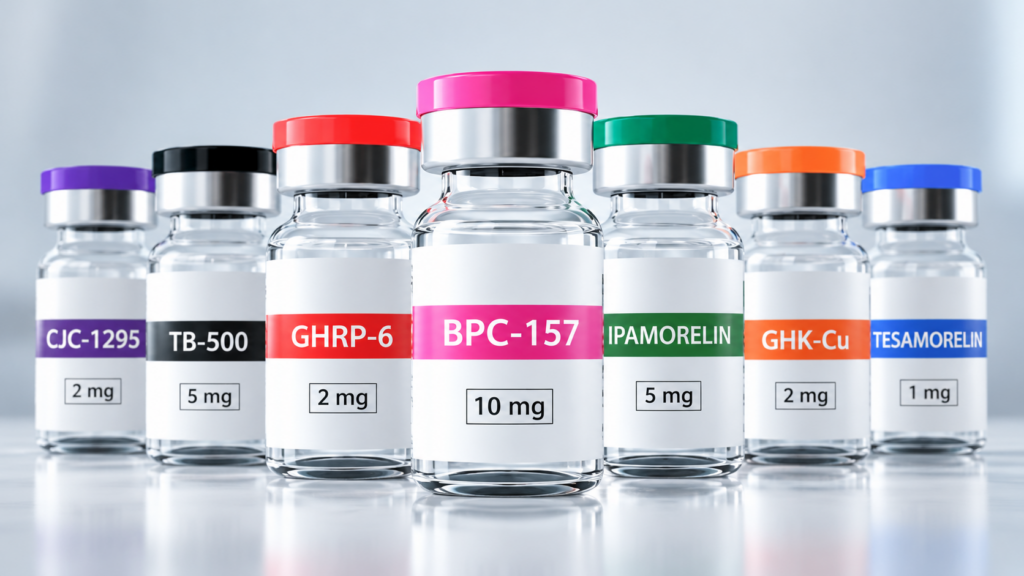
The Peptide Craze: What Are Peptides, Do They Work, and Are They Safe?
Peptides have become one of the latest trends in health, wellness, and anti-aging medicine. They are being promoted for weight loss, muscle growth, improved skin quality, faster healing, increased energy, and even longevity.
Some of these claims are supported by remarkable advances in medical science. Others are based on preliminary research, theoretical benefits, or little meaningful human evidence.
The confusion comes from treating peptides as though they are all part of one therapeutic category.
They are not.
Some peptides are established medications with decades of clinical experience. Others are experimental compounds that have never demonstrated safety or effectiveness in properly conducted human studies.
Understanding the difference is particularly important as peptide injections become increasingly available through wellness clinics, online pharmacies, and direct-to-consumer companies.
What Are Peptides?
Peptides are molecules made of amino acids, the same building blocks that make up proteins.
When amino acids connect, they form chains. Short chains are generally called peptides, while longer, more complex chains are often classified as proteins. There is no universally agreed-upon cutoff between the two.
The sequence of amino acids determines the structure and biological activity of the molecule.
Our bodies naturally produce many peptides that regulate essential functions, including metabolism, appetite, hormonal signaling, inflammation, and tissue repair.
Some act as chemical messengers, allowing cells and organs to communicate. Others influence specific receptors or biological pathways.
Scientists can also manufacture peptides designed to reproduce or modify these natural processes.
The important distinction is that the word peptide describes a molecule’s structure, not its safety, effectiveness, or medical purpose.
Two peptides may be chemically similar yet have entirely different effects on the body.
Are Peptides New to Medicine?
No. Peptides have been used in medicine for decades.
Insulin, a small protein hormone, is one of the earliest and most important examples of a medication built from amino acid chains. Other established peptide medications include glucagon, teriparatide for osteoporosis, and certain hormonal therapies.
More recently, semaglutide and tirzepatide have transformed the treatment of obesity and type 2 diabetes.
These medications act on specific metabolic pathways involved in appetite, blood glucose regulation, and energy balance. Their effectiveness has been demonstrated in large clinical trials, and their benefits and risks have been extensively studied.
Their success is an important medical achievement.
But it has also helped fuel the current peptide craze.
The reasoning often seems to be that if one peptide can produce dramatic weight loss, perhaps other peptides can stimulate healing, reverse aging, or improve physical performance.
That assumption is scientifically flawed.
The effectiveness of one peptide tells us nothing about the effectiveness of another. Each compound must be evaluated independently.
Why Have Peptides Suddenly Become So Popular?
The recent enthusiasm reflects several developments occurring simultaneously.
The success of GLP-1-based medications has demonstrated that carefully designed peptide drugs can produce substantial clinical benefits.
At the same time, advances in biotechnology have made it easier to manufacture and study compounds that influence specific biological pathways.
Social media and wellness marketing have accelerated public interest by promoting peptides for conditions that conventional medicine cannot always treat easily.
Chronic tendon injuries, aging skin, loss of muscle mass, fatigue, and slow recovery are frustrating problems. Treatments promising to improve these conditions naturally attract attention.
The problem arises when the promise of a biological mechanism is presented as evidence of a clinical result.
A peptide may stimulate a particular cellular pathway in laboratory experiments. That does not mean injecting it into a human will produce the desired effect.
And even if a treatment produces a measurable biological change, that change may not translate into a meaningful health benefit.
Which Peptides Are Proven to Work?
There are FDA-approved peptide-based medications with well-established clinical benefits.
Examples include semaglutide and tirzepatide for certain metabolic conditions, teriparatide for selected patients with osteoporosis, and several peptide-based hormonal medications.
These treatments have been evaluated for specific medical indications.
However, many compounds currently promoted in wellness and anti-aging clinics have a very different evidence base.
BPC-157 and TB-500: Do They Improve Healing?
BPC-157 and TB-500 are frequently advertised for tendon injuries, muscle recovery, wound healing, and postoperative recovery.
Their appeal is understandable. Healing involves inflammation, blood vessel formation, collagen production, and tissue remodeling. A compound capable of influencing these processes could potentially have therapeutic value.
But potential is not proof.
Much of the interest in these peptides comes from laboratory and animal studies. High-quality human clinical evidence demonstrating meaningful improvements in healing remains insufficient.
For a surgeon, the relevant question is not whether a compound can influence healing in an experimental model.
It is whether that compound improves outcomes in actual patients.
Does it reduce wound complications? Improve scar quality? Strengthen a tendon repair? Shorten recovery without increasing other risks?
Until those questions are answered through appropriate clinical studies, claims of proven healing benefits are premature.
CJC-1295 and Ipamorelin: Do They Improve Muscle Growth or Reverse Aging?
These peptides are promoted for their effects on growth hormone signaling.
Growth hormone plays an important role in metabolism, growth, and tissue maintenance. However, increasing growth hormone activity does not automatically translate into better health, improved athletic performance, or slower aging.
Hormonal pathways are complex, and altering one component can affect multiple systems.
There is insufficient high-quality evidence to support routine use of these compounds for general anti-aging or wellness purposes.
Potential adverse effects and uncertainties regarding long-term safety must also be considered.
GHK-Cu: Can Copper Peptides Rejuvenate Skin?
GHK-Cu is a copper-binding peptide that has attracted attention for its possible effects on skin biology, collagen-related processes, and wound repair.
It is found in some topical skin-care formulations and is also marketed in injectable preparations.
These are two very different applications.
Laboratory findings suggesting biological activity do not necessarily establish visible skin rejuvenation in patients. Topical formulations must also overcome challenges involving stability, penetration, and delivery into the skin.
Evidence for specific cosmetic formulations remains variable.
Injectable GHK-Cu raises additional safety questions because systemic exposure, sterility, impurities, and immune responses are different concerns from those associated with topical application.
A peptide that may have potential as a cosmetic ingredient should not automatically be considered safe for injection.
What Is the Difference Between FDA-Approved and Experimental Peptides?
This is probably the most important distinction for consumers.
The FDA evaluates medications for safety and effectiveness before approving them for specific medical uses.
The approval process generally involves laboratory research, clinical studies, manufacturing evaluation, and analysis of whether the expected benefits outweigh the risks.
FDA approval does not mean that a medication is free of side effects.
It means there is sufficient evidence to support its use for an approved indication under specified conditions.
An experimental peptide has not necessarily undergone this process.
Some experimental compounds are being studied in legitimate clinical trials. Others are sold commercially despite having little reliable human evidence.
A product can be available for purchase without being an FDA-approved medication.
Availability is not evidence of effectiveness, and a prescription alone does not establish FDA approval.
Are Compounded Peptides FDA-Approved?
Compounding is the process of preparing a medication for a particular medical need.
For example, a patient may require a specific formulation that is not available in an approved commercial product.
Compounding can be an important part of legitimate medical care.
However, compounded medications are not individually FDA-approved, and they do not undergo the same premarket review for safety, effectiveness, and quality as approved medications.
Compounding pharmacies and outsourcing facilities are subject to applicable federal and state requirements, but these requirements do not make every compounded medication equivalent to an FDA-approved drug.
There are also restrictions on which substances may legally be used in compounding.
The FDA has identified safety concerns involving several peptides marketed for wellness purposes, including BPC-157, CJC-1295, ipamorelin, and certain injectable copper-peptide formulations.
These concerns include limited human safety information, possible immune reactions, and problems related to peptide impurities or manufacturing.
Patients should not assume that a product is proven safe simply because it is dispensed by a pharmacy or administered in a medical office.
What Does “Research Use Only” Mean on a Peptide Label?
Some peptides are sold online with labels stating that they are intended for research and not for human consumption.
These labels are commonly associated with products intended for laboratory use rather than approved medical treatment.
They do not establish that the substance is safe to inject.
A research product may not have been manufactured or tested to the standards required for an injectable medication.
Purity, concentration, sterility, and consistency may be uncertain.
For an injectable product, these concerns are particularly significant because contamination or dosing errors can produce serious complications.
Patients should be especially cautious when products marketed for research are accompanied by instructions or advertising encouraging personal use.
Are Peptide Supplements and Peptide Skin-Care Products Regulated Differently?
Yes. The FDA regulates medications, dietary supplements, and cosmetics under different legal frameworks.
An FDA-approved medication has undergone review for its specified medical use.
Dietary supplements generally do not require FDA approval before marketing. Manufacturers are responsible for meeting applicable safety and labeling requirements, and supplements cannot legally be marketed with unapproved claims to treat or cure diseases.
Cosmetics, including most skin-care products, are generally not subject to premarket FDA approval, although they must comply with applicable safety and labeling laws.
A peptide-containing cream marketed to improve the appearance of skin is therefore not evaluated in the same way as an injectable medication intended to alter a physiological process.
These distinctions matter because the word peptide may appear on products with very different levels of regulatory oversight.
How Can You Tell Whether a Peptide Treatment Is Safe and Effective?
When considering any new peptide treatment, I would focus on a few questions.
What is the exact compound? A general description such as peptide therapy provides very little useful information.
Is the treatment FDA-approved for the proposed use? If not, understand whether it is an investigational drug, a compounded medication, or a cosmetic product.
What human studies demonstrate its benefits? Laboratory experiments and animal studies may justify further investigation, but they do not establish clinical effectiveness.
What are the known risks? Side effects, drug interactions, immune responses, and long-term consequences are all relevant.
Who manufactures the product? This is particularly important for injectable preparations, where sterility and accurate dosing are essential.
Is there an established treatment that accomplishes the same goal? A newer treatment is not necessarily more effective than an existing one.
I would also be cautious about claims that a single peptide can improve numerous unrelated conditions, particularly when those claims are supported primarily by testimonials.
Can Peptides Improve Healing After Plastic Surgery?
As a plastic surgeon, I am particularly interested in advances that may improve tissue healing, reduce complications, and produce better long-term results.
But healing is not a single biological event.
It involves an organized sequence of inflammation, cellular activity, blood vessel formation, collagen deposition, and tissue remodeling.
These processes must occur in the appropriate balance.
Stimulating one component of healing does not necessarily improve the overall result. In some circumstances, altering a normal biological response could potentially have unintended consequences.
For example, a compound that increases cellular activity in laboratory studies might appear promising for wound healing. But before using it in surgical patients, we need evidence that it improves actual clinical outcomes.
Does the incision heal more reliably? Is the scar better? Is tissue strength improved? Are complication rates reduced?
At present, there is insufficient clinical evidence to recommend experimental peptides such as BPC-157 or TB-500 routinely for improving recovery after cosmetic surgery.
Patients considering surgery should disclose any peptides or other substances they are taking, including those obtained from wellness clinics or online sources.
My Perspective: Promising Science Should Not Be Confused With Proven Medicine
I have spent much of my career watching surgical techniques and medical treatments evolve.
Some innovations have meaningfully improved patient care. Others generated considerable enthusiasm before their limitations became apparent.
One lesson that experience has reinforced is that a treatment should be judged by its results, not by how sophisticated its scientific explanation sounds.
Peptide medicine is a legitimate and rapidly developing field.
The success of established peptide-based medications demonstrates what carefully conducted research can accomplish.
But the current enthusiasm has created a market in which proven medications, experimental compounds, and cosmetic products are frequently discussed as though they are interchangeable.
They are not.
I am optimistic that continued research will identify additional peptide therapies with meaningful clinical benefits.
Until then, patients should distinguish between what is biologically plausible, what is supported by preliminary research, and what has actually been demonstrated to be safe and effective in humans.
The most important question is not whether a treatment is a peptide.
It is whether that particular peptide has been shown to provide a meaningful benefit with an acceptable level of risk.
Good medicine should be driven by evidence, not enthusiasm.
Afshin Parhiscar, MD, FACS
Double Board-Certified Plastic Surgeon
Walnut Creek, California
Frequently Asked Questions About Peptide Therapy
What is a peptide in simple terms?
A peptide is a chain of amino acids, the building blocks of proteins. Some peptides act as hormones or chemical messengers, while others are manufactured for medical or research purposes.
Are all peptides safe?
No. Safety depends on the specific peptide, dose, route of administration, manufacturing quality, and individual patient factors. Being a peptide does not make a substance inherently safe.
Are peptide injections FDA-approved?
Some injectable peptide medications are FDA-approved for specific conditions. Many peptides promoted for anti-aging, muscle growth, or healing are not FDA-approved for those purposes.
Does BPC-157 actually heal tendons or injuries?
Laboratory and animal research has generated interest, but there is insufficient reliable human clinical evidence to establish BPC-157 as an effective treatment for tendon injuries or postoperative healing.
Are compounded peptides the same as FDA-approved medications?
No. Compounded drugs are not individually FDA-approved and do not undergo the same premarket review. Compounding may be appropriate for particular medical needs when applicable legal requirements are met.
Are copper peptides effective for skin rejuvenation?
Some laboratory and limited clinical research suggests potential cosmetic benefits, but results depend on the specific formulation and evidence. Topical copper peptides should not be confused with injectable GHK-Cu.
Should I use peptides to recover faster after plastic surgery?
Experimental peptides have not been shown through adequate clinical studies to improve routine cosmetic surgery recovery. Discuss any peptide use with your surgeon before surgery.