
Case of the Month: Using Imaging to Create a Rhinoplasty Plan Together
Every rhinoplasty begins with a conversation. Patients often know what they would like to change, but it can be difficult to describe exactly how a new nasal shape will look on their own face.
For this patient, the consultation was focused on creating a more refined, balanced nasal appearance while preserving a result that still felt natural and authentic to her. Rather than moving immediately to a surgical plan, we began by carefully reviewing her photographs and discussing the features she liked, the features she wanted to improve, and the degree of change that felt right for her.
Imaging as a Communication Tool
I use individualized computer imaging with every rhinoplasty consultation. Imaging is not a promise or a guarantee of a surgical result. Instead, it is one of the most valuable communication tools we have.
It allows the patient and me to look at potential changes together: refining the bridge, adjusting tip definition or rotation, improving symmetry, or modifying the profile. More importantly, it allows us to compare variations.
A patient may initially think that they want a very small nose, a highly rotated tip, or a dramatic reduction in the bridge. But when they see those changes placed on their own face, they may realize that a more subtle refinement feels more like them. Other patients see a proposed change and feel confident that they would like a stronger adjustment. The goal is to understand not only what a patient dislikes about the nose, but what level of change they will genuinely be happy living with.
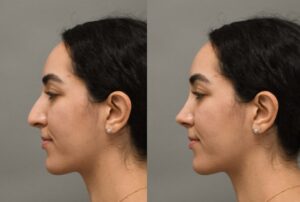 This version is a little upturned
 This version has more slope
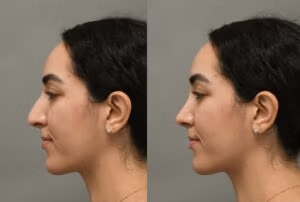 This was her preferred version
From Imaging to Surgical Planning
In this case, we reviewed several imaging variations together before settling on a plan that created greater harmony without making the nose look overdone. The final simulation became our shared visual reference: not a guarantee, but a clear expression of the patient’s goals and the direction of surgery.
The operation was then designed to achieve those agreed-upon changes while maintaining structural support and respecting the patient’s unique anatomy. Rhinoplasty is not a matter of simply reproducing an image. The surgeon must translate the patient’s aesthetic goals into a stable, functional, three-dimensional surgical plan.

The Result
The final postoperative photographs show the value of that process. The patient’s nose is more refined and balanced, while still appearing natural for her face. The result reflects the same priorities we identified during the consultation: improvement, proportion, and preservation of identity.
For me, imaging is not about showing patients an unrealistic “after.” It is about giving them a meaningful way to participate in the design of their result. When patients can see potential changes on themselves, compare alternatives, and decide what feels right, we begin surgery with greater clarity, stronger communication, and a truly individualized plan.