
How I Choose Breast Implant Size: A Plastic Surgeon’s Approach
One of the most common questions patients ask during a breast augmentation consultation is, “What size implants should I get?”
It seems like a straightforward question, but choosing the right breast implant involves much more than selecting a number of cubic centimeters (cc).
In my practice, I approach breast implant selection by considering two equally important factors: what the patient wants to achieve and what her anatomy will reasonably accommodate.
The goal is not simply to make the breasts larger. It is to create a result that reflects the patient’s aesthetic preferences while respecting her individual anatomy.
What Is the Ideal Breast Size?
Before discussing implant size, I think it is important to ask a more fundamental question: What makes a breast attractive?
There is no single answer.
Breast aesthetics are subjective. What one person considers ideal, another may find too large, too small, too round, or too natural. Some women prefer a subtle increase in volume that is difficult to distinguish from their natural breasts. Others want greater fullness, more pronounced cleavage, or a rounder upper breast.
Neither preference is inherently right or wrong.
As a plastic surgeon, my role is not to impose my personal definition of the ideal breast. It is to understand what each patient finds attractive and determine how closely we can achieve that result within the limitations of her anatomy.
The ideal breast augmentation is one that reflects the patient’s aesthetic goals while maintaining appropriate proportions, tissue support, and long-term breast health.
Step 1: Understanding the Patient’s Goals
The first thing I do during a breast augmentation consultation is listen.
Before taking measurements or discussing implant sizes, I want to understand the patient, her aesthetic preferences, and why she is considering surgery.
What does she like about her current breasts? What would she like to change? Is she looking for a modest increase in volume, restoration of fullness after pregnancy or weight loss, or a more noticeable enhancement?
I also want to understand her personal taste.
Two patients with nearly identical anatomy may want completely different results. One may prefer a soft, natural breast contour, while the other may want more upper-pole fullness and a distinctly augmented appearance.
Reference photographs can be particularly helpful. They allow patients to communicate preferences that are sometimes difficult to describe in words. Rather than focusing on the implant size used in a photograph, I look at the breast shape, fullness, projection, and overall proportions the patient finds attractive.
This conversation establishes our aesthetic destination.
Only then do I begin evaluating how we can achieve it.
Step 2: Evaluating Breast Anatomy
Every woman’s breasts and chest wall are different. Even the two breasts of the same patient are rarely identical.
A careful physical examination is therefore essential to choosing an appropriate implant.
During the examination, I evaluate several anatomical characteristics.
| Anatomical feature | Why it matters for implant selection |
|---|---|
| Existing breast size and volume | Determines how much natural breast tissue is present and how much additional volume may be needed |
| Breast base width | Helps establish the appropriate implant diameter and limits how wide an implant can reasonably be |
| Breast shape | Influences how the implant will change the overall contour, including the upper and lower poles |
| Skin quality and elasticity | Determines how readily the breast envelope can accommodate additional volume |
| Breast tissue thickness | Affects implant coverage, visibility, palpability, and the potential for rippling |
| Nipple–areola complex (NAC) position | Helps identify breast ptosis, asymmetry, and whether augmentation alone can achieve the desired result |
| Chest wall and rib cage shape | Influences implant orientation, projection, cleavage, and the apparent symmetry of the breasts |
| Breast symmetry | Identifies differences in breast volume, width, shape, and nipple position that may influence implant selection |
| Inframammary fold (IMF) position | Helps determine implant positioning, lower-pole dimensions, and whether fold adjustment may be necessary |
These anatomical features do not independently determine implant size. They must be considered together.
For example, a patient with thin breast tissue and limited skin elasticity may not accommodate a large implant as comfortably or predictably as someone with thicker tissue and a more generous breast envelope.
Similarly, an implant that appears attractive on a patient with a broad chest may create a very different result on someone with a narrow chest.
Understanding these differences is essential to producing a balanced result.
Step 3: Breast Width Determines the Starting Point
Once I understand the patient’s goals and have evaluated her anatomy, one of the first measurements I consider is the breast base width.
Breast base width is the horizontal dimension of the breast footprint on the chest wall.
This measurement helps establish the appropriate base diameter of the implant.
An implant that is too wide for the patient’s anatomy may extend excessively toward the sides of the chest or create undesirable fullness near the midline. An implant that is too narrow may fail to produce the desired breast shape or distribution of volume.
The objective is to select an implant width that works with the patient’s natural breast footprint and chest wall.
However, breast width is a starting point, not an absolute rule. Existing tissue, the desired breast shape, implant position, and individual anatomical variations may justify adjustments.
I generally begin with breast width because it helps define the implant’s footprint before deciding how much projection and volume are appropriate.
Step 4: Choosing Implant Projection and Volume
Once I have established an appropriate range of implant diameters, the next consideration is projection.
Projection describes how far the implant extends forward from the chest wall.
Breast implants are available in different profiles, commonly described as moderate, moderate-plus, high, and extra-high projection, although terminology varies among manufacturers.
Two implants can have similar base diameters but substantially different volumes because one projects farther forward than the other.
For example, consider two hypothetical implants with approximately the same base width:
- Implant A: Lower projection, less volume, and a relatively subtle increase in fullness.
- Implant B: Higher projection, greater volume, and a more pronounced forward breast contour.
Both may fit within a similar breast footprint, yet they can create very different aesthetic results.
This is why choosing an implant based solely on its volume in cubic centimeters can be misleading.
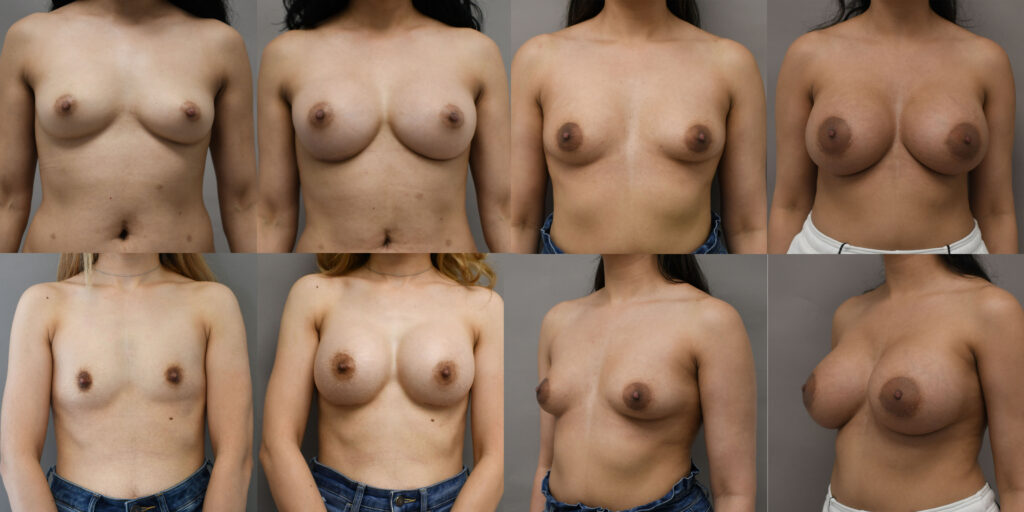
A 350 cc implant does not produce the same appearance in every patient. The result depends on the implant’s dimensions, the patient’s existing breast tissue, skin envelope, chest wall, and overall proportions.
I use the patient’s aesthetic goals to guide the choice of projection and volume within the range that her anatomy can appropriately support.
Step 5: Balancing the Desired Result With Anatomical Limitations
Although patient preference guides the aesthetic goal, anatomy determines what can reasonably and safely be achieved.
A patient may prefer a particular breast size or appearance, but the amount of existing tissue, breast width, skin elasticity, and chest wall dimensions may limit which implants are appropriate.
Choosing an implant that is disproportionately large for the available tissue can increase the risk of implant visibility, rippling, tissue stretching, implant malposition, and changes in breast shape over time.
These considerations are particularly important for patients with thin breast tissue or limited soft-tissue support.
Occasionally, a patient’s desired result may require more than selecting a different implant. Breast asymmetry, significant ptosis, or differences in inframammary fold position may require additional surgical planning. In some patients, a breast lift may be necessary to achieve the intended shape.
My responsibility is to explain these limitations clearly and help the patient understand the trade-offs involved.
The best implant is not necessarily the largest implant that can be placed. It is the implant that achieves the desired appearance while remaining appropriate for the patient’s anatomy.
Why I Don’t Choose Breast Implants Based on Cup Size Alone
Patients frequently describe their goals in terms of bra cup size, such as wanting to go from a B cup to a C or D cup.
Although this provides a useful starting point for understanding their preferences, cup size is not a precise measurement of breast volume.
Bra sizing varies among manufacturers, and the same implant can produce different cup sizes in patients with different chest dimensions and existing breast tissue.
For this reason, I place greater emphasis on the appearance the patient wants to achieve, the dimensions of her breasts, and the physical characteristics of the implant.
The goal is to choose the implant that produces the desired shape and proportion, rather than selecting a volume based on an anticipated bra size.
How Do I Know Which Breast Implant Size Is Right for Me?
There is no universal formula for choosing the ideal breast implant size.
The process begins with understanding your aesthetic preferences and continues with a detailed evaluation of your breast anatomy.
Breast width helps determine the implant’s base diameter. Projection and volume are then selected to create the desired fullness and shape, while accounting for tissue quality, breast position, symmetry, and chest wall anatomy.
The final decision is a balance between what you want and what your anatomy can appropriately accommodate.
My Philosophy on Breast Implant Selection
After more than 25 years in plastic surgery, I believe one of the most important aspects of breast augmentation is understanding that patients do not all share the same definition of beauty.
My goal is not to give every patient the same breast shape or size.
It is to listen carefully, understand her individual aesthetic preferences, evaluate her anatomy, and use sound surgical principles to develop a plan that brings those two elements together.
Breast implant selection begins with the patient’s goals, is guided by her anatomy, and is refined through careful consideration of implant width, projection, and volume.
That is how I approach breast augmentation in my Walnut Creek practice, serving patients throughout the East Bay and San Francisco Bay Area.
Frequently Asked Questions
How does a plastic surgeon determine breast implant size?
A plastic surgeon considers the patient’s aesthetic goals, existing breast volume, breast base width, skin elasticity, tissue thickness, chest wall anatomy, and breast symmetry. Implant diameter, projection, and volume are selected together rather than relying on cup size or implant volume alone.
Is breast implant width more important than volume?
Breast width is an important starting measurement because it helps determine the implant’s appropriate footprint. However, projection, volume, tissue characteristics, and the desired aesthetic result are also essential.
What is the difference between implant volume and projection?
Volume is the amount of space an implant occupies, measured in cubic centimeters (cc). Projection is how far the implant extends forward from the chest wall. Implants with similar base diameters may have different volumes because their projections differ.
Can two patients receive the same implant size and have different results?
Yes. Existing breast tissue, chest width, skin elasticity, breast shape, and implant placement all influence the final appearance. The same implant can produce substantially different results in different patients.
Can breast augmentation correct breast asymmetry?
Breast augmentation can improve certain differences in breast volume and shape. Depending on the anatomy, different implant dimensions, adjustments to the inframammary folds, or an additional breast lift may be considered. Perfect symmetry cannot be guaranteed.