

How Can I Restore My Body After Having Children?
If you’re wondering why your body doesn’t look the same after pregnancy—even after you’ve lost the baby weight—you’re not alone. Pregnancy changes the body in predictable ways that exercise and dieting alone often cannot reverse.
The five most common changes are:
- Separated abdominal muscles (diastasis recti), creating a persistent lower abdominal bulge.
- Loose abdominal skin and stretch marks, especially below the belly button.
- Stubborn fat deposits around the waist, lower back, and flanks that may remain despite weight loss.
- Loss of breast volume or breast sagging after pregnancy and breastfeeding.
- Changes in body proportions, including flattening of the buttocks and loss of the waist-to-hip contour.
The encouraging news is that each of these problems can be treated. The key is identifying which changes are present and choosing the right combination of procedures rather than assuming one operation will address everything.
In my practice, I don’t think of a Mommy Makeover as simply combining procedures. I think of it as restoring your body’s natural proportions while tailoring the plan to your anatomy, your goals, and your lifestyle.

1. Separation of the Abdominal Wall
As the uterus expands, the abdominal muscles stretch apart to make room for the baby. This separation, known as diastasis recti, occurs primarily in the lower abdomen between the belly button and the pubic bone.
After pregnancy, these muscles often do not return completely to their original position. As a result, many women develop a persistent lower abdominal bulge or “pooch.”
This is not simply excess fat. It is a structural problem caused by separation of the abdominal wall, and no amount of exercise or weight loss can completely repair it.
2. Stretching of the Abdominal Skin
The skin also stretches dramatically during pregnancy, especially below the belly button.
Once the skin has been stretched beyond its ability to recoil, it loses elasticity. Stretch marks develop as the deeper layers of the skin tear during expansion.
Although skincare products can improve skin quality, they cannot remove excess skin or eliminate stretch marks that have developed in stretched skin.
3. Changes in Fat Distribution
Many women find that, even after returning to their pre-pregnancy weight, their body shape has changed.
Fat often accumulates in areas such as:
The lower abdomen
The flanks (“love handles”)
The lower back
The waist
These changes alter the body’s natural curves and can make clothing fit differently than before pregnancy.
4. Loss of Buttock Shape
Pregnancy and the demands of caring for young children often lead to changes in activity level and muscle conditioning.
Over time, many women develop decreased muscle volume and tone in the gluteal region, particularly involving the gluteus medius muscles. Combined with changes in fat distribution, this can make the buttocks appear flatter and reduce the youthful transition between the waist, hips, and buttocks.
How Do I Restore My Body?
The goal is not simply to make someone thinner.
The goal is to restore the body’s natural proportions while addressing the structural changes that pregnancy created.
For many women, this involves four components.
Restore the Abdominal Wall
The separated abdominal muscles are repaired and returned to their normal position. This recreates the internal support of the abdomen and produces a flatter, stronger abdominal contour.
Restore the Skin
The excess skin that developed during pregnancy—along with the stretch marks located on that skin—is removed.
Since the majority of stretch marks occur on the lower abdomen, removing this skin often eliminates many of the visible stretch marks while tightening the remaining skin.
Restore Body Contours
Liposuction is used to remove excess fat from areas that commonly change after pregnancy, including the abdomen, waist, flanks, and lower back.
Rather than simply removing fat, I view liposuction as a sculpting procedure that restores natural curves and recreates balanced body proportions.
Restore the Buttocks When Appropriate
Not every patient needs buttock enhancement, but for selected women, restoring volume and contour to the buttocks can dramatically improve the overall silhouette.
This may be accomplished using your own fat, strategically transferred to create natural projection and improve the relationship between the waist, hips, and buttocks. The goal is always a balanced, elegant contour—not an exaggerated appearance.
Every Patient Is Different
No two women experience pregnancy the same way, and no two patients require the same operation.
Some patients primarily need repair of the abdominal wall. Others benefit most from skin removal. Many require contouring of the waist and lower back, while some also benefit from restoring buttock shape.
The key is to evaluate the body as a whole rather than treating each area in isolation.
The Case Featured Below
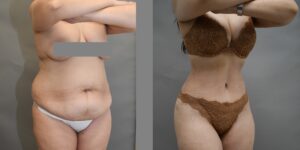


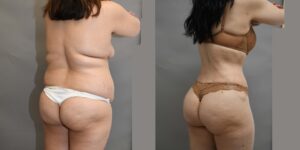

The patient shown in the photographs above experienced the common changes many women see after pregnancy: stretching of the abdominal wall, excess lower abdominal skin with stretch marks, stubborn fat deposits around the waist and lower back, and loss of youthful body proportions.
Her surgical plan focused on restoring each of these changes individually while maintaining natural anatomy and balance.
The result is not simply a flatter abdomen—it is restoration of the body’s overall proportions, creating a shape that is strong, feminine, and natural.
My philosophy has always been that body contouring is not about making someone look different (unless they want that). It is about helping them regain the body that pregnancy changed while preserving what makes them uniquely themselves. Every woman experiences pregnancy differently. During consultation, I evaluate each component of the body separately, the abdominal wall, skin quality, fat distribution, breast position, and overall body proportions. Together we develop a surgical plan designed specifically for your anatomy and goals rather than applying the same operation to every patient.